Fabrication & Engineering
Production of 3D tissue structures, bioinks, printing parameters, cell integration, microstructuring, photopolymerization, scaffold design, mechanical properties, biocompatibility.
3D Culture and Maturation
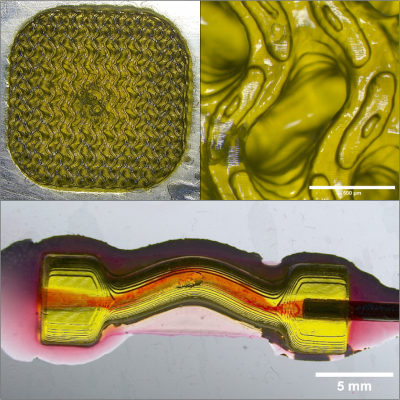
By using three-dimensional cell culture systems, we create microenvironments that closely mimic nature, in which cardiovascular and musculoskeletal tissue can mature under physiological conditions. These tissue constructs are produced using extrusion-based 3D printing and biomolding as key biofabrication methods. Both methods enable the reproducible production of defined architectures and anatomically relevant geometries with controlled porosity and high dimensional accuracy. By specifically varying process parameters, matrix stiffness, and bioactivity, the constructs can be tailored to different applications. In addition to established biomaterials, we also use collagen hydrogels that are manufactured and formulated in-house. The resulting constructs are cultured in dynamic bioreactor systems that enable a controlled supply of nutrients, mechanical conditioning, and long-term analysis. Biomechanical stimulation and the use of customized scaffolds specifically promote the structural and functional organization of the cells. At the same time, the developed perfusion systems simulate the mechanical forces of native tissue environments, thereby accelerating tissue maturation. Our goal: is to develop functional models that allow for detailed investigation of the function-structure relationships of complex tissues.
mSLAb-Light-Based Bioprinting
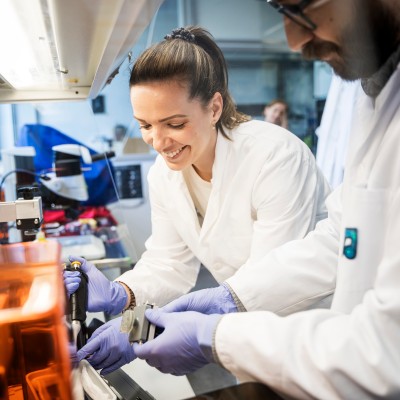
On our mSLAb platform, we use light‑based masked stereolithography (mSLA) to rapidly fabricate 3D tissue scaffolds from ECM‑derived hydrogels such as GelMA, achieving fine structural resolution and short printing times. By combining temperature‑ and humidity‑controlled processes with customized printing hardware designed for small‑batch production, we can reliably process protein‑based bioresins, including cell‑laden formulations. A key strength of mSLA is the ability to adjust stiffness during the printing process: by regulating light dose and exposure time, we generate constructs with tissue‑specific mechanical properties and even stiffness gradients within a single print. Our goal: scalable, perfusable tissue models with controllable architecture and biomechanics.
Laser Induced Forward Transfer (LIFT)
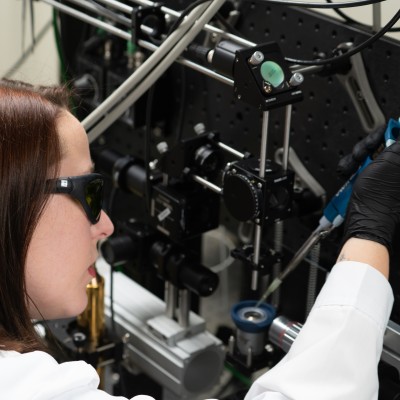
With our advanced LIFT technology (Laser‑Induced Forward Transfer), we can position living cells — from single cells to multicellular spheroids — precisely where they are needed, without any physical contact. Our film‑free, microscope‑integrated approach uses ultrashort near‑infrared laser pulses, which confine energy deposition to a tiny focal volume, minimize photothermal stress, and eliminate the need for contaminating absorber layers. This enables optically guided cell selection (e.g., based on morphology or fluorescence) and highly precise 2D/3D cell patterning on or within printed protein scaffolds. Our goal: combining precise matrix fabrication with precise cellular organization — particularly for tissues in which the spatial arrangement of cells is functionally critical.
Two-Photon Polyimerization (2PP)
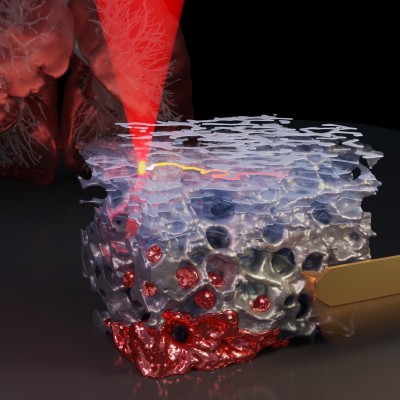
Our Nanoscribe 2PP technology enables ultra‑high‑resolution 3D microfabrication of tissue microarchitectures that cannot be achieved with conventional bioprinting methods. Using protein‑based bioresins (including GelMA and BSA), we fabricate complex structures such as alveolus‑like architectures and microvascular features at dimensions where geometry begins to dictate cellular behavior and mass transport. Because polymerization is confined to the laser focus, 2PP allows local control over crosslinking density and mechanical properties, enabling the creation of precisely structured mechanical microenvironments for mechanobiology. Our goal: biomimetic microstructures that make tissue function measurable at the cellular and subcellular level.
Cell Migration and Invasion (3-Dimensional)
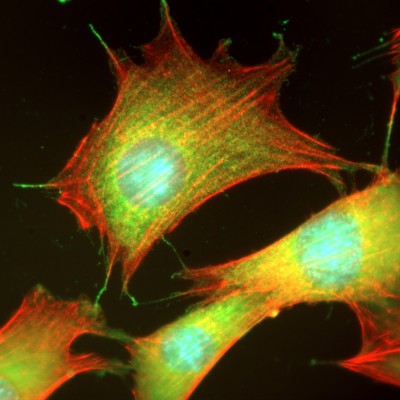
Three‑dimensional migration assays enable the investigation of cellular motility under physiologically relevant conditions and expand the capabilities of classical two‑dimensional approaches such as scratch assays. By systematically comparing 2D and 3D datasets, conventional migration metrics can be validated and translated into a spatial context. The focus lies on the influence of varying hydrogel compositions and matrix stiffnesses on migration speed, directionality, and invasion depth. Analyzing these parameters provides fundamental insights into the mechanobiological interactions between cells and the extracellular matrix. The resulting design criteria directly inform the optimization of scaffold architectures for tissue engineering.